-
1
Drive from Kathmandu to Besisahar (823m.)
You drive along the Kathmandu-Pokhara Highway to Dumre and then follow the narrow and paved road by the Marshyangdi River to Beshisahar, the district headquarters of Lamjung district. Stay overnight at lodge.
-
2
Trek from Beshishahar to Bahundanda (1305m.)
The first part of the trail passes on a flat level along the bank of the Marshyangdi river. You can enjoy the sceneries and the local culture of Gurung community. After lunch the trail goes steeply up to Bahundanda and takes about 2 hours. From this point you are surrounded by the breathtaking beauty of the snowcapped mountains. Stay overnight at lodge.
-
3
Trek from Bahundanda to Chamje (1410m.)
A steep trail descends for early half an hour and then follows a flat path through rice terraces before crossing a stream at the bottom of a small waterfall. It then climbs again and traverses the hillside high above the river before reaching the village of Lali Gaon. Ahead the Marshyangdi valley forms a steep V-shape and you follow the winding mountain path down through Syange (1100m.) where there is a beautiful waterfall above and along the river for some distance. The trail then climbs steeply and the path is cut into the sheer cliff-face some 200-300m above the riverbed. The trail then begins to observe small ups and downs to Chamje through the forests. Stay overnight at lodge.
-
4
Trek from Chamje (1410m.) to Dharapani (1960m.)
The first part of the trail descends to the river and after crossing a suspension bridge, you begin a climb to Sattale (1550m.) on a path so steep that it seems one slip would send you hurtling down into the valley. You continue on an undulating path above the river. Climbing the zigzag path to the top of the hill, you see the level, plain of Tal (1700m.) before you. You descend to a grassy riverbank that leads to Tal with its hotels and teahouses. Here you can enjoy the exhilarating waterfalls. Beyond Tal, the valley narrows and the path becomes high and winding and in several areas hewn from the rock itself. Beyond the small village of Karte (1900m.), there is a bit more cliff-walking before the path drops again to the river. You cross a suspension bridge and climb the short distance to the stone Mani marking the entrance to Dharapani (1960m.), and your camp for the night. Stay overnight at lodge.
-
5
Trek from Dharapani to Koto
You trek a gradually ascending path and cross a stream to reach Koto. The mountain views you can enjoy are of Annapurna II, Manaslu range and beautiful views of forests on the way add another dimension to your trek. Koto is a small village mainly inhabited by Gurung and others whose lifestyles are mainly influenced by Buddhist Tibetans. Stay overnight in camp.
-
6
Trek from Koto to Dharmasala
You cross the river leading to the Nar Phu valley and hike up through beautiful woods above the Phu Khola. The route takes you through some beautiful woods and past several small caves, and a pilgrims’ Dharmasala. After you emerge out of a narrow canyon, the trail actually passes under a wide waterfall just before Dharmasala, from where the woods become thinner and the vistas wider. Stay overnight in camp.
-
7
Trek from Dharmasala to Kayang
A steep climb up the valley along a small, scenic river brings you finally to high pastures on a 3,200m plateau. You pass by scenic kharka of Meta, 3560m, a non permanent winter settlement of Nar, where you are likely to share the trail with a few yaks! This morning is one of the loveliest walks in the Himalayas. Stay overnight in camp.
-
8
Trek from Kayang to Phu village.
Dropping steeply down to the river, you trek for a while along the river bank and past the “submarine” rock, passing some small possible campsites along the way. You start to see some of the unique, colorful chortens for which Nar and Phu are famous. You have to walk carefully across a small glacial stream before reaching a larger one with a bridge only half covered with large slabs of slate. Another hour and a half of trekking through scenic canyon and gorges, you reach the Phu gate. This ancient gate provides you with you first view of the three villages of Phu, as well as an old “dzong” and the remains of the two forts, all now in ruins, but impressively situated atop the flatlands before Phu. Stay overnight in camp.
-
9
Excursion around Phu valley.
You can have interaction with locals and explore the wide valley systems above you. You might walk up the valley to the summer grazing settlement or Kharka at Ngoru, a three hour’s walk past the gompa. Phu itself is an incredibly interesting village and you can observe the villagers spinning their yak and sheep wool and chat. Stay overnight in camp.
-
10
Trek from Phu valley to Junam.
You get back through Phu gate, descend to the river and retrace your steps back to Junam Kharka, which is a lovely spot for camping. Stay overnight in camp.
-
11
Trek from Junam to Nar.
This day you trek down the old bridge spanning a deep, contoured and narrow gorge and all the way back up again. The scenery is stunning. Below you sits Gyalbu Kumbu, built in 1650, and Satte Gompa, both empty. You finally reach the Nar gates at the top of the hill, and pass by yet another line of wonderfully painted, bamboo topped chortens before turning the corner and being rewarded with sublime views of Nar, the undulating patterns of the surrounding barley and mustard fields, four old colorful and traditional Gompas and the snow peaks looming overhead. Stay overnight in camp.
-
12
Explore Nar village. Nar is bit more social and lively than Phu.
Explore Nar village. Nar is bit more social and lively than Phu. Stay overnight in camp.
-
13
Trek from Nar village to Ngwal after crossing Kang La pass.
The Kang La is not a difficult pass, but it could be a long day if there is snow. The Kang La, at 5240m, is an absolutely spectacular pass looking over Annapurna II, Gangapurna, Tilicho peak, the peaks surrounding Tilicho and the airport at Hongde. The trail down is steep and then gradually down towards the end. Ngawal, on the upper Pisang route of the Annapurna circuit (off the main Annapurna circuit), can be reached in as little as two hours from the pass, but the walk down is so nice that you will take it easy and enjoy the views. Just before Ngawal is an unusual grouping of chortens and prayer flags, and marks a meditation cave far up in the hills. Ngawal is a wonderful, old village of cobbled streets, prayer wheels and beautiful architecture, obviously a hub of religious activity in previous times. Stay overnight in camp.
-
14
Trek from Ngwal to Manang
This day you walk on a leveled path along the bank of the Marshyangdi river to reach Manang. On the way you pass pine forests, villages such as Braga and farming terraces. You can enjoy the views of Annapurna range, Tilicho Mountain and beautiful landscapes. Manang is a small town. Stay overnight in lodge.
-
15
Trek from Manang to Khangsar
The path is a gradual descent and you cross a suspension bridge over Jharsing Khola (stream). You trek on dry land though you can see shrubs on the both sides. The panoramic views of Annapurna range completely mesmerize you. Khangsar is a Gurung village where you find a small monastery, chorten, Mani walls and prayer flags. Stay overnight in camp.
-
16
Trek from Khangsar to Tilicho Lake
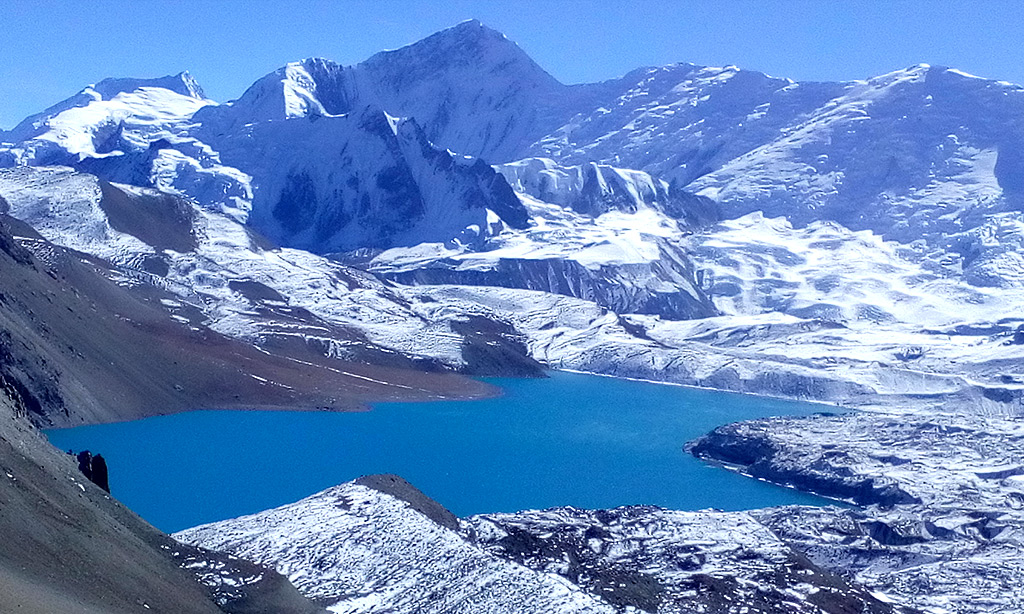
The path is covered by small crystals and shrubs can be seen on both sides. From here you can also enjoy the closer and panoramic views of Tilicho Mountain and many others. Stay overnight in camp.
-
17
Trek from Tilicho Lake to Mesokanto Pass (5315m.)
The trail is quite narrow and you trek over an icy path. The panoramic views of Annapurna range, Tilicho, Dhaulagiri along with more than ten mountains completely mesmerize you. Stay overnight in camp.
-
18
Trek from Mesokanto Pass to Jomsom (2741 m.) via Thimi (2760 m.)
From Mesokanto Pass, the trail goes steeply down through pine forests to Jomsom. Before you reach Jomsom, you cross Thimi inhabited by mostly Buddhists. Stay overnight at lodge.
-
19
Fly from Jomsom to Pokhara
The flights are available during the morning time. A strong breeze blows during and after and frequent changes of the weather prevent flights from taking off and landing in the afternoon. Stay overnight at hotel in Pokhara.
-
20
Drive from Pokhara to Kathmandu by bus
While driving from Pokhara to Kathmandu, you head up to Damauli, Dumre, Muglin and Kurintar where Nepal's first Cable car is operated to reach Manakamana Temple. En route, you can enjoy mountain views, green sceneries, rice terrace fields, vegetable fields and people being engaged in their daily life activities. From Naubishe you climb up to Thankot, the gateway to Kathmandu.